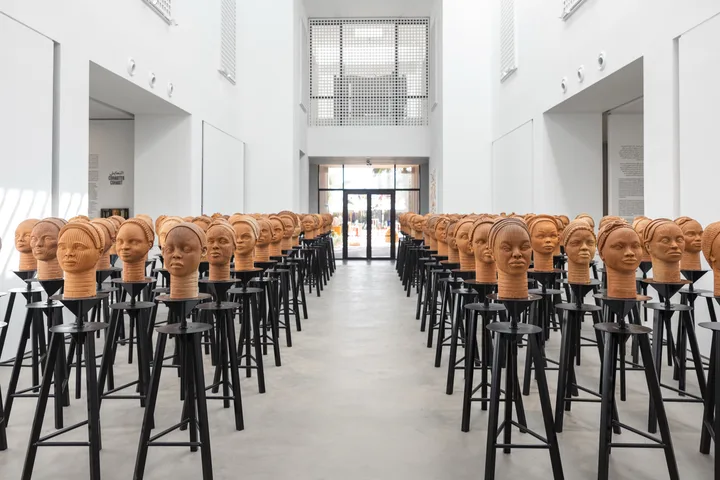
Let's start here, with one hundred and eight clay heads, each one shaped by many hands. Look across the Atrium first. The figures read as a group, a silent assembly in the same fired earth tone, roughly the same scale. Now walk closer. The differences are in the surfaces: a thumb dragged across a brow, fingers pressed into a cheek.
A small group of portraits started this project. A hundred and eight ended up here. Prune Nourry didn't make them alone. Students from the Obafemi Awolowo University at Ile-Ife in Nigeria worked alongside women potters, in solidarity with the mothers and families of the Chibok girls.
Those girls were two hundred and seventy-six students taken by Boko Haram from their school in northeastern Nigeria in April two thousand and fourteen. Some escaped. Ten years later, dozens are still missing. Their families are still waiting.
The tradition they worked inside is centuries old. Ile-Ife was the center of Yoruba civilization, and its artists made terracotta heads long before outsiders wrote about them, heads built to hold memory. Nourry worked with that tradition, in the community it belongs to.
Monuments are usually decided above people's heads, about them rather than with them. This one was made with them. The Catharsis Arts Foundation, which Nourry co-founded in New York, exists to keep that kind of making alive.
Look at the head nearest to you. Someone pressed their thumbs into it. You can still see where.
Cent huit têtes en argile, réunies ici, chacune façonnée par de nombreuses mains. C'est par ce chiffre que tout commence.
Regardez d'abord l'Atrium dans son ensemble. Les figures forment un groupe, une assemblée silencieuse dans cette même terre cuite, à peu près à la même échelle. Approchez-vous maintenant. Ce qui change, c'est la surface : un pouce tiré sur un front, des doigts enfoncés dans une joue, des gestes laissés visibles dans l'argile. Tout a commencé par un petit groupe de portraits. Cent huit têtes ont fini par se retrouver ici.
Prune Nourry a construit cette installation à travers une collaboration qui a traversé les frontières et les générations. Des étudiants de l'Université Obafemi Awolowo d'Ile-Ife, au Nigeria, ont travaillé aux côtés de potières, en solidarité avec les mères et les familles des filles de Chibok. Ces jeunes filles étaient deux cent soixante-seize élèves, enlevées par Boko Haram dans leur école du nord-est du Nigeria en avril deux mille quatorze. Certaines se sont échappées. En deux mille vingt-quatre, des dizaines sont toujours portées disparues. Les familles au cœur de ce mémorial attendent encore.
La tradition dans laquelle ce travail s'inscrit a plusieurs siècles. Ile-Ife était le centre de la civilisation yoruba, et ses artistes modelaient des têtes en terre cuite bien avant que tout regard extérieur ne les documente, avec une précision et une dignité faites pour conserver la mémoire. Nourry a travaillé en dialogue avec cette tradition, au sein de la communauté à qui elle appartient.
La construction des monuments a longtemps été une décision prise sans consulter les concernés, sur eux plutôt qu'avec eux. Ici, le mémorial a été façonné par des mains collectives. La Catharsis Arts Foundation, que Nourry a cofondée à New York, existe pour maintenir ce type de création vivant, en amplifiant les voix que les institutions écartent habituellement.
Regardez la tête la plus proche de vous. La surface est irrégulière, travaillée, humaine. Quelqu'un a posé ses pouces là. C'est un témoignage, retenu dans l'argile.
تأمّل أولًا الباحة الداخلية ككلّ. تتجمّع هذه الرؤوس في لقاء صامت، جميعها من الفخّار نفسه، وبأحجام متقاربة. اقترب الآن. ما يختلف هو السطح: أثر إبهام سُحب على جبين، وأصابع غاصت في خدّ، وحركات بقيت آثارها ظاهرة في الطين. بدأ كلّ شيء بمجموعة صغيرة من الرؤوس المنحوتة، وانتهى بمئة وثمانية رؤوس اجتمعت هنا.
أنجزت برون نوري هذا التركيب الفني من خلال تعاون تجاوز الحدود وجمع بين الأجيال. فقد عمل طلاب من جامعة أوبافيمي أوولوو في إيلِه إيفِه بنيجيريا إلى جانب حرفيّات صناعة الفخار، تضامنًا مع أمهات فتيات شيبوك وعائلاتهنّ.
كانت هؤلاء الفتيات مئتين وستًّا وسبعين تلميذة، اختطفتهنّ جماعة بوكو حرام من مدرستهنّ في شمال شرق نيجيريا في أبريل 2014. تمكّنت بعضهنّ من الفرار، لكن حتى عام 2024، ظلّت العشرات منهنّ في عداد المفقودات. وما زالت العائلات التي يتمحور حولها هذا العمل التذكاري تنتظر.
يندرج هذا العمل ضمن تقليد فني يعود إلى قرون عدّة. فقد كانت إيلِه إيفِه مركزًا لحضارة اليوروبا، وكان فنّانوها يشكّلون رؤوسًا من الفخّار قبل وقت طويل من توثيقها على أيدي القادمين من خارجها، بدقّة ووقار يحفظان الذاكرة. وقد عملت نوري في حوار مع هذا التقليد، داخل المجتمع الذي ينتمي إليه.
لطالما كان تشييد النُّصُب التذكارية قرارًا يُتَّخذ دون استشارة المعنيّين بها؛ فتُقام عنهم بدلًا من أن تُنجَز بمشاركتهم. أمّا هنا، فقد تشكّل هذا النصب التذكاري بأيدٍ جماعية. وتسعى مؤسسة «كاثارسيس للفنون»، التي شاركت نوري في تأسيسها في نيويورك، إلى إبقاء هذا النوع من الإبداع حيًّا، وإيصال الأصوات التي عادةً ما تستبعدها المؤسسات.
تأمّل الرأس الأقرب إليك. سطحه غير منتظم، وتظهر عليه آثار التشكيل واللمسة الإنسانية. لقد وضع أحدهم إبهامَيه هنا. إنّها شهادة حُفظت في الطين.